
The Pokémon All 22 craze that seemingly came out of nowhere this month has spread like wildfire, and it was made for people like me.
I’ve been playing Pokémon in some capacity since I was a kid, starting with the original Red Version, which I got when I was six, and the first Base Set booster packs I ever opened. I still remember pulling a holographic Chansey from that first pack and feeling like I’d won the lottery when I saw its 120 HP. And, of course, I got the Starter Set with Machamp and the coin inside.
I’ve also been a die-hard NFL fan — and, tragically, a cursed New York Jets fan — since middle school, when I watched the Jets beat Peyton Manning and the Indianapolis Colts in the playoffs 41–0. It was mostly downhill from there, but I still watch football every Sunday in the fall, play in two long-running fantasy leagues, and enjoy arguing with my friends about which coaches stink and which quarterbacks are doing things we’ve never seen before
All of which is to say, I’m a pretty typical nerdy American in his mid-30s who loves his handful of hobbies and interests that tie my adult and childhood together.
Like I said, Pokémon All 22 was tailor-made for someone like me. But as I’ve watched these hypothetical Pokémon football teams pop up in my Reddit, X, and YouTube feeds over the past week, one thing has become painfully obvious: Most people don’t know what the fuck they’re doing.
How are we putting someone without limbs — or without any way to carry the ball — at running back? How is a two-and-a-half-foot mouse standing in the pocket at quarterback behind a 20-plus-foot rock snake at center? What’s an 87-pound plant going to do at guard against a 1,000-pound bear? How’s a ground-bound Dugtrio supposed to play defensive back against a fucking bird?
What are we thinking, people?
Look, I know Pokémon All 22 is all in good fun. People love thinking about football, and any nostalgia kick we OG Pokémon fans get from revisiting the games we grew up with is a welcome escape from our usual adult routines. It’s why I return to the games every few years and get hooked for a month or so at a time. Sometimes, you just need to feel like a kid again — especially after a day spent hanging out with a kid of your own.
Everyone’s free to enjoy the game however they see fit, and the brilliant All 22 Pokémon website’s quick rise and success offer a great way to explore Pokémon from a new angle and have some fun for five or 10 minutes during the workday.
But for me, the basic stat calculations All 22 Pokémon uses to determine a Pokémon’s effectiveness at each position aren’t enough. I like to tinker with my team. I like to consider all the angles. Simply plugging the heaviest guy in at center and the fastest guy in at running back doesn’t cut it for me.
That’s why I’m working to build the best, most realistic All 22 lineups for each Pokémon generation, starting with Generation I.
Is there any point to all this? Absolutely not. I’m not expecting anyone to actually read this other than the seven people I sent it to — if I’m lucky.
Am I spending way too much time at night working on this when I should be sleeping? Of course! There’s no bigger waste of time than painstakingly examining the stats, weights, and heights of fictional animals for a hypothetical football game against a nonexistent opposing team.
But has it been a lot of fun to do this week? Hell yeah!
Ground Rules and Assumptions
Now, let’s get into the specifics of what I’m trying to build here. I want to put together a realistic, effective football squad based on each Pokémon’s base stats, abilities, moveset, and physical makeup.
First, I’m assuming standard NFL rules and penalties apply. I won’t spend time explaining every rule, but if something seems like a penalty — say, a lineman wrapping (holding) a defender with its tentacles or knocking someone out with a punch or kick — it probably is.
Flight and levitation are generally allowed, but within reason. Let’s assume there’s an invisible out-of-bounds ceiling at around 15 feet. Otherwise, a Flying-type could simply soar out of reach of ground-based defenders and swoop back down into the end zone without resistance.
I’m also assuming that, while plenty of Pokémon can shoot magical projectiles at their opponents — water, fire balls, lightning bolts, rocks — this is a physical sport. Fire Blasting a wide receiver in the middle of a route or sniping the QB from a distance with Hyper Beam just doesn’t feel like football, so these moves are banned.
Similarly, magically levitating or launching the ball with psychic abilities, or having it float alongside you while you run, seems a little cheap. You can’t have possession if the ball is floating in midair, after all. It’s fun to imagine, but it feels like using a cheat code if your Alakazam can make the opposing team float away, teleport into the end zone, or use Psychic to guide the ball around defenders and straight into a teammate’s hands.
We’re also ruling out most protection moves, like Reflect, Light Screen, Protect, Detect, and moves that cause confusion, sleep, or other status conditions.
We are allowing most self-enhancing stat-boosting moves, such as Harden and Bulk Up. We’re also allowing most physical attacks that don’t involve punching or kicking. Tackle, Quick Attack, Volt Tackle, Take Down and similar moves are fair game, as are grappling or grabbing moves like Wrap and Vicegrip that could help a Pokémon catch the ball or bring down a ball carrier on defense.
If you’re a ball carrier or receiver, you need some way to hold the ball — hands, a big mouth, claws, even large wings could work, provided the mechanics are plausible.
Last, I’m excluding Legendary Pokémon. Mewtwo would be an incredible QB, but their stats are just too high.
Interpreting the base stats
The final piece of the puzzle is figuring out what each base stat translates to on a football field.
When looking at a Pokémon’s base stats, consider: a stat of 120 or better shows an elite ability (about a top 5% performer), 100-119 is great, 85-99 is good, 60-85 is average ability, and everything below thata is below average or bad (lower than a 35 is terrible, or the bottom 5%).
This is my interpretation, not necessarily how the All 22 Pokémon website calculates its ratings.
HP: This represents in-game stamina. Since we’re not building an entire depth chart or simulating fatigue over a full season, HP isn’t particularly relevant to our discussion.
Attack: This represents physical strength — whether that’s trucking a defender, bull-rushing an offensive lineman, or bringing down a ball carrier. For quarterbacks, it also contributes to arm strength, although it’s not the only factor that goes into throwing the ball.
Defense: This represents a Pokémon’s sturdiness when going up against an opponent. It primarily contributes to blocking along the offensive line, though it can also help a Pokémon hold its ground elsewhere on either side of the ball.
Special Attack: We’re not allowing magical projectiles, but those Special Attack skills best translate to passing accuracy, versatility, and general intelligence.
Special Defense: This represents a Pokémon’s composure and its ability to evade or withstand an opponents’ efforts.
Speed: This is how fast can a Pokémon move. Pretty self-explanatory, but important.
Finally — before I forget — height, weight and other physical traits like body type, appendages and the Pokemon’s relationship with the ground — can they actually walk, can they float or are they stuck in one spot forever? — are all taken into consideration.
The Results
Without further ado, here are my Generation I rosters, along with explanations for each selection.
Pokemon All 22 team: Kanto – Gen.1
The Quarterback
Picking my quarterback was the most difficult part of this exercise because there are a handful of traits an NFL quarterback absolutely must have. He needs functioning limbs, or some other legitimate way to throw a football accurately and with enough velocity to get it downfield. He needs to be reasonably mobile, durable enough to take an occasional hit, and tall enough to see the field over his offensive line.
I initially gravitated toward humanoid Pokémon, particularly Psychic-types. Even if they can’t use their psychic abilities to send the ball across the field, they’re generally cerebral and tend to have high Special Attack stats.
I first considered Alakazam, who has elite quickness (120 Speed) and exceptional processing and accuracy potential (135 Special Attack), but limited arm and physical strength (50 Attack). He’s also short. If you told me he had Kyler Murray’s body and speed with Chad Pennington’s arm and football IQ, I could get on board! But at 4’11”, he’s awfully small to play under center, especially with a limited deep ball.
Golduck is closer to a traditional quarterback build. At 5’7″, he’s still tiny by NFL standards, but that’s manageable in the PokeLeague, and his attributes are well-rounded across the board. He’s got some psychic abilities, even if he’s not technically a Psychic-type. Still, I picture him as more of a Bo Nix or Ryan Fitzpatrick type: capable, mobile, but not necessarily a special talent.
Hypno was another option. He reminds me of Big Ben: slow but bulky, with a solid arm, a slightly creepy vibe, and those Steelers-esque yellow colors. But once again, I worried about his height at 5’3″.
I had to think outside the box if I wanted a special talent. That’s where Charizard comes in.
Charizard – Quarterback
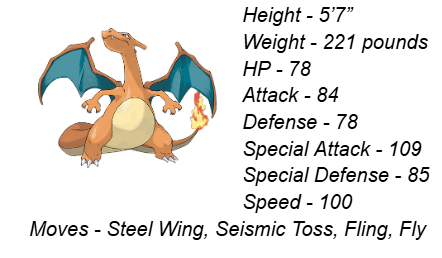
Charizard is still a little short, but he’s got a powerful build, plenty of speed, and wings that let him rise above the offensive line when necessary. He’s got that big, “fuck you” arrogance, the willingness to take shots downfield, and a high Special Attack stat that makes me think he’ll combine accuracy with serious arm strength. Plus, his wings could help him protect the ball, escape pressure and brush off defenders. And his Blaze ability makes him stronger as he gets tired, which could get me some comebacks if the team falls behind.
He does have small hands, which gave me pause, but he learns moves involving throwing and launching objects, including Rock Tomb, Fling, and Seismic Toss. That’s all the evidence I need to convince myself this will work.
I know Charizard’s versatility could make him valuable at several other positions, especially on defense. But if he’s a combination of Aaron Rodgers’ attitude and Josh Allen’s overwhelming physicality and arm talent, you’re getting a fantastic quarterback.
Running Back
There are plenty of ways to approach this position, but you’re obviously looking for a combination of strength, speed, elusiveness, and durability, along with the ability to hold onto the ball. (Sorry, Electrode. You are a ball, but you can’t carry one.)
I thought about Raichu, who has great Speed (110) and agility, along with passable strength (90 Attack). But he’s pretty slight, even for a running back. As much as I want him to be LeSean McCoy, I think he’s probably closer to Darren Sproles, if we’re lucky. Sandslash has a bigger build but lacks the Speed (65). Electabuzz is 3’7″ and has 105 Speed, but he’s not as strong or as elusive as I’d like. I also considered Tauros, who’s bulky (90 Defense), strong (100 Attack), and fast (110 Speed). The problem is that I’m not sure he can reliably carry the ball with that small mouth. I have the same concerns about Jolteon.
Rapidash looked like my best option. At 5’7″ and 200 pounds, he’s a realistic size for an NFL running back, and carrying the ball in his mouth seems…plausible? His Attack (100) should let him break through the line consistently, while his Speed (105) gives him enough juice to make plays in the open field even if he’s not a true burner. Quick Attack does give him extra burst, while Agility makes him shifty. He could be a well-rounded back, and I thought he was going to be my guy…
But then I thought, why can’t Gyarados be Derrick Henry?
Gyarados – Running Back
I’ll fully admit that this seems like nonsense, and I’m not entirely sure it fits the spirit of my own guidelines.
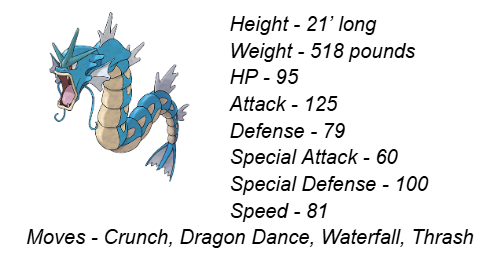
For starters, Gyarados is a 20-plus-foot flying sea serpent with no limbs.His Speed tops out at 81, which isn’t terrible overall but is slow for a running back. He’s also not exactly what comes to mind when you picture a ball carrier. He literally can’t run on the ground.
But I can confidently say he can hold the ball in his mouth. He learns Crunch and Bite, after all. And when you consider everything else, he’s overwhelming.
His Attack dwarfs that of the other serious contenders, giving him the strength to overpower some of the toughest defenders head-to-head. His defense isn’t spectacular, but is a cut above the other backs in the tryout room. He should be able to take hits and hold onto the ball, while his Special Defense will let him slip through enough tackles, too.
And, as I mentioned earlier, he can fly. He doesn’t even have to break through the line. He can just float over it.
Now, there are a few downsides. The Derrick Henry comparison works because Henry is an absolute freak of nature when it comes to size and strength, but Gyarados lacks Henry’s top-end speed. Once Henry gets going, he fucking flies. Gyarados’s lack of limbs also creates a unique problem: If any part of his body touches the ground while he’s carrying the ball, he’s down by contact. There might be a way to exploit that if he can’t outrun defenders, but I just can’t get past the image of him plowing straight through people. And with Intimidate as an ability, what defender is going to want to square up against that thing one-on-one?
If you call bullshit on the logistics of having a 21-foot long snake in the backfield and say it’s not in the spirit of the parameters I created, then Rapidash is my selection. But, fuck it, Gyarados.
Wide Receivers
For my wide receivers, I’m looking for Pokémon that are fast and tall, have sure hands (or some other plausible way to catch the ball), and can win contested catches. Flight is an obvious bonus.
Aerodactyl – Wide Reciever
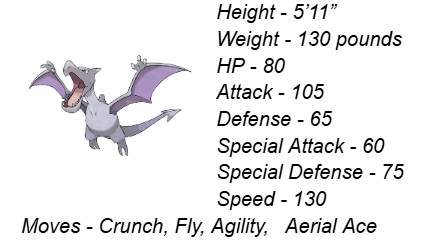
Aerodactyl has the second-highest speed stat is Gen. 1, behind Electrode, who doesn’t have any limbs. He’s a good height, and among the flying Pokémon in the game, he has the most realistic ways to catch a ball, whether it’s with his hands, jaws, or talons, or by corralling it against his wings. His Rock Head Ability should let him withstand some big hits in traffic. Plus, Aerodactyl is fucking awesome. He’s selling jerseys after he Odell Beckham’s defenders on jump balls.
Dodrio – Wide Reciever
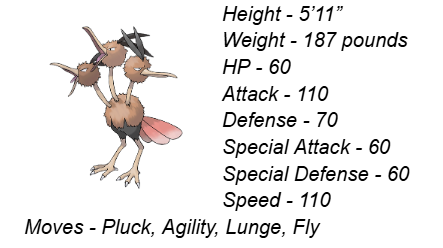
Maybe I’m assuming too much by thinking Dodrio can catch the ball in its beak or wings, but learning Pluck makes me optimistic. If it can, it’s got great speed and solid height. Plus, his three heads are a huge advantage: One can track the ball, another can monitor the route, and the third can scan the field for coverage. Three beaks to catch the ball also give Dodrio a potential edge over two-handed contenders. And despite what you might assume, Dodrio can learn Fly, too.
Tentacruel – Wide Reciever
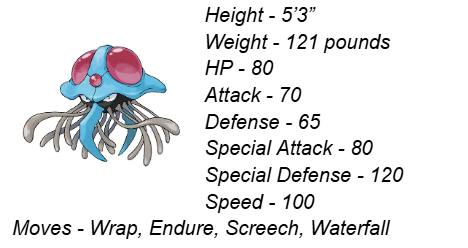
Tentacruel defies a few assumptions you might make just by looking at it. They’re surprisingly small, but shockingly fast for a stout, alien-looking jellyfish monster. I’m banking on a huge catch radius thanks to those tentacles, which should help Tentacruel beat press coverage and reach over defenders to haul in contested balls, while the Defense and Specail Defense makes them slippery to take down.
Tight End
Tight ends need height, enough power to hold a block, and sufficient speed to run routes and create mismatches. I considered Kangaskhan for its height and Victreebel for its huge mouth and vines, which could help it snatch the ball. Tight end might be a lower-priority position in this exercise, but I’m going all out.
Dragonite – Tight End
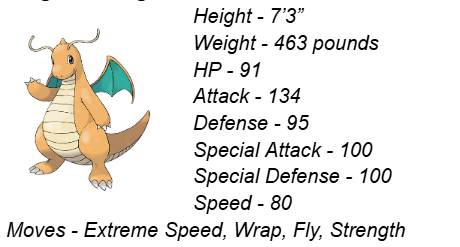
Dragonite feels like he could be plugged in almost anywhere on the field. I considered him for both the offensive and defensive lines, and those might be more valuable positions. But I got pretty infatuated with the idea of a 7’3″ tight end who can truck defenders, block a bit, move with decent speed, and fly to make a play on the ball. He’s practically guaranteed to be the Pokémon equivalent of Gronk or Travis Kelce, with some extra burst on routes thanks to Extreme Speed.
Offensive line
Building the offensive line is harder than you’d think. A lot of Pokémon are much smaller than you’d expect, and once you start looking at their height-to-weight ratios, things get wacky. Graveler is a 3’3” rock that weighs 231 pounds. Fine. But somehow, he weighs half as much as Onix, who’s also rock and 28-feet long, who himself weighs less than the 4’11”, 661-pound Golem. Then there’s Snorlax, who’s 6’11” and weighs more than 1,000 pounds, while 7’3″ Kangaskhan checks in at just 174 pounds — about 10 pounds lighter than the 5’11” Dodrio. It’s weird.
In the NFL, offensive linemen are generally somewhere between 6’1″ and 6’7″. You also don’t want someone so big or immobile that they clog up running lanes or create problems for the quarterback. That doesn’t leave us with many options, which means we’ll have to lean more heavily on other attributes when a Pokémon’s size isn’t a perfect fit.
I’m ruling out a few obvious candidates right away for various reasons. Snorlax is better suited to the defensive line, Onix is simply too enormous, Graveler and Sandslash are too short, and Kangaskhan is too light.
Here’s the line I’m going with.
Rhydon – Left Tackle
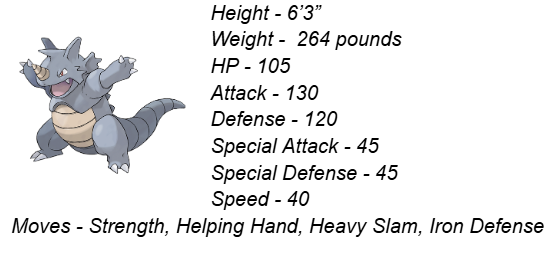
Rhydon could be an excellent defensive player thanks to his attack power, but he’s slow, heavy, and has too much defensive ability to pass up on the offensive line. He’s got the ideal build for an NFL lineman, with the size and strength to hold up against elite pass rushers.
Cloyster – Left Guard
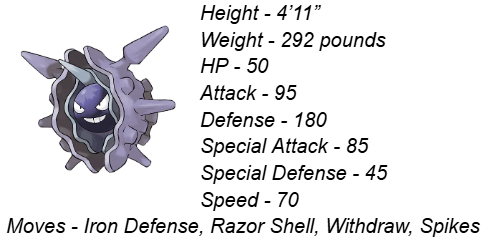
Cloyster is short and lacks appendages, which could be a problem against shifty pass rushers. But his weight and elite Defense — the highest in Generation I — make him a no-brainer. He should also be mobile enough to pull in the run game. And his spikes, combined with moves like Iron Defense and Withdraw, would make him an absolute pain in the ass to go up against.
Ditto – Center
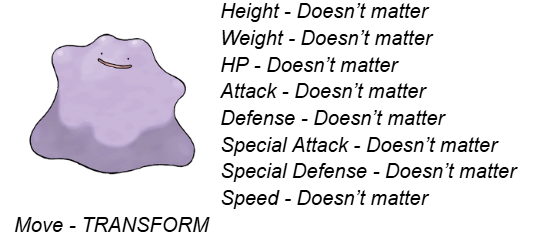
Using Ditto in any capacity feels like cheating, but with limited options, having someone who can transform into one of your best linemen, or copy the other team’s best nose tackle to neutralize them is absolutely the right and only real move.
Golem – Right Guard
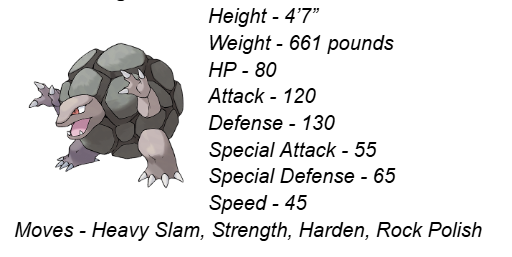
Golem is short, but he’s as stout as they come, with an elite combination of Defense and weight. With his Sturdy ability giving him second chances against big rushers, I’m confident he can be a rock on the line and hold his ground against the best defensive linemen in the league.
Venusaur – Right Tackle
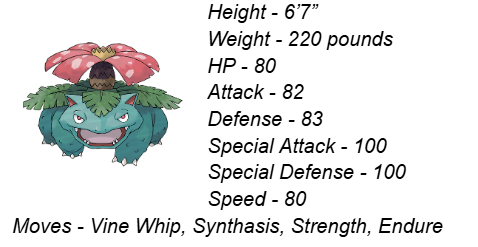
Venusaur is a good size and has average-to-above-average attributes across the board. His vines should help extend his reach against versatile or multiple pass rushers, while his decent speed should make him useful in the run game and against quicker defenders. I wish his Defense were a little higher, but I think his overall size and athleticism will make up for it, especially alongside the other tanks on this line. For his moveset, I’m bankin on consistancy and quick recovery.
If Ditto’s not allowed, I would move Venusaur to center, and either put Blastoise or Lapras at Right Tackle. Blastoise is taller than my guards but still undersized for the position. That said, he has very good Defense and durability, while his Special stats and agility should give him the tools to handle most average-sized pass rushers. Lapras has a few shortcomings — he has flippers but no real arms, his Defense is pretty average, and I don’t know if they can really move outside of water. But, compared to everyone else who’s left, Lapras is physically enormous, and should be able to slow down pass rushers. My hesitation is he’s a little too tall, and the lack of mobility could make him an impediment to the playmakers.
Defense
Defensive Line
On the defensive line, you need to balance weight, power, and speed. You want enough bulk to stop the run while still generating pressure on the quarterback. Nose Tackles are huge, powerful and stout, while edge rushers need size, power and speed.
I decided to run a 3-4 defense because, when you’ve got a Nose Tackle as oppressively large and strong as the one I’ve picked, it’s hard to find a second interior lineman who makes sense with him.
Snorlax – Nose Tackle
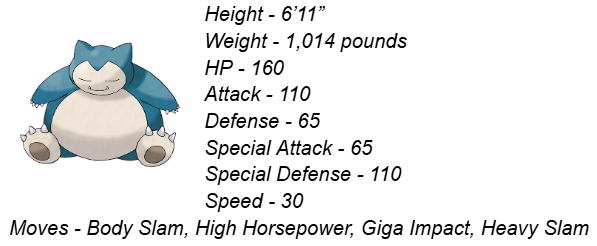
Snorlax at Nose Tackle is probably the most obvious selection in this entire exercise. His sheer size and relatively low Defense might make him a hindrance on the offensive line, but on defense, he’s the best run stopper you could ask for. Nobody’s pushing him backward, and he’s got the power to bust through the line himself. He’s like if Vince Wilfork ate Dexter Lawrence and Kris Jenkins.
Rapidash – Defensive End
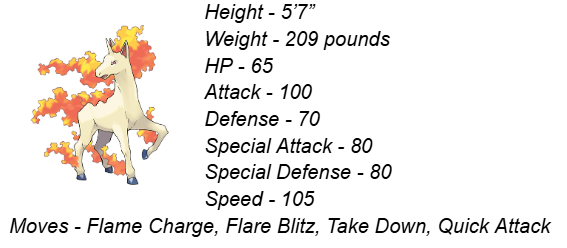
After being left at the altar at running back, Rapidash has found a home on the defensive line — and honestly, it’s a better fit. The speed, power and weight combo works here, and moves like Flare “Blitz” and Flame “Rush” sound like the perfect tools for getting after the passer.
Tauros – Defensive End
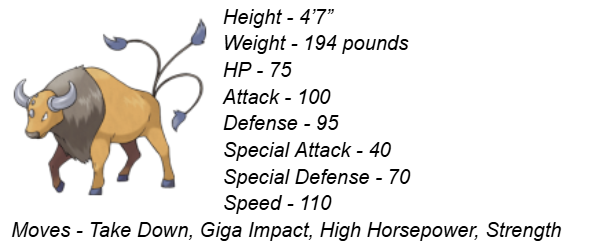
Sure, Tauros could have been a badass fullback, but he’s also a prototypical edge rusher, combining speed, drive, and power. His moveset fits the position perfectly, too.
Linebackers
Like edge rushers, linebackers need speed and power to pressure the quarterback. But they also need enough coverage ability to help out the secondary and a reliable way to bring down ball carriers.
Arcanine – Outside Linebacker
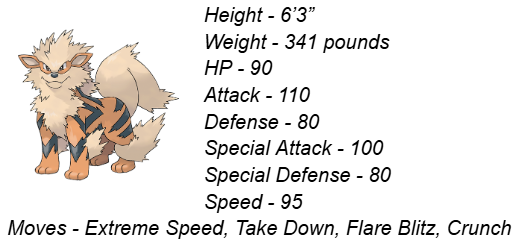
Look at Arcanine’s fucking size. You’d never guess from looking at him that he’s one of the biggest Pokémon in Generation I. He’s eighth in height (excluding the five serpentine Pokémon, whose lengths make the comparison a little weird) and sixth in weight, behind only Snorlax, Golem, Gyarados, Lapras, and Dragonite. That’s it! That’s the list!
With his size, speed, and moves like Extreme Speed and Flare Blitz, I think he’ll be terrifying whether he’s lining up as an edge rusher or patrolling the middle of the field looking to deliver a huge hit.
Machamp – Inside Linebacker
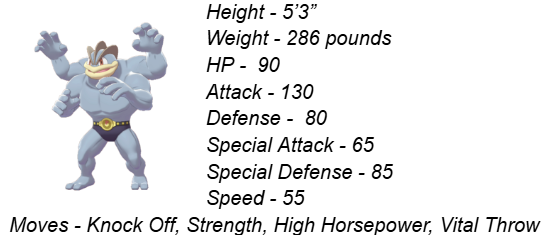
I couldn’t build a team without Machamp, a four-armed freak of nature whose muscular build would be perfect for the NFL — if he weren’t just 5’3″ and an astonishing 286 pounds. I don’t know how you fit that much flesh into that compact of a body, but it explains why his speed is so underwhelming. Still, his strength is massive, and those four arms give him the reach to wrap up ball carriers and make sure they aren’t escaping.
Pinsir – Inside Linebacker
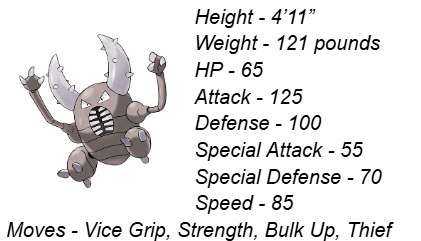
There are a bunch of attack-first Pokemon who could fit at inside linebacker, but none really stands out above the rest. I considered Kingler’s claws and huge Attack (130), and Kabutop’s scythe-like arms, and the speed/power combo of Primeape or Raticate, while Nidoking has a more well-rounded profile. Ultimately, I’m going with Pinsir. Its Attack stands out, its Speed is above average, and those horns on its head should make wrapping up opponents a lot easier.
Scyther – Outside Linebacker
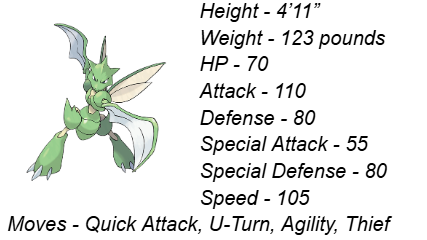
With its scythe-like arms and agility, Scyther would have some killer counter moves as a pass rusher. But I’m picturing it more as a nickel defensive back with linebacker skills as a bonus. With wings, Scyther’s agile and quick enough to keep up with slot receivers or to cover a zone, and strong enough to tackle in the open field. Scyther probably won’t catch many balls with its blades, but should break up plenty of passes and get a handful of sacks over a season.
Secondary
I want my secondary full of Pokémon who can fly — both figuratively and literally. When you’re going up against winged receivers, not being able to get airborne yourself is a huge disadvantage. DBs also need to be able to tackle in the open field, although physical strength isn’t as important as the ability to stick with a route runner and contest passes.
Pidgeot – Cornerback
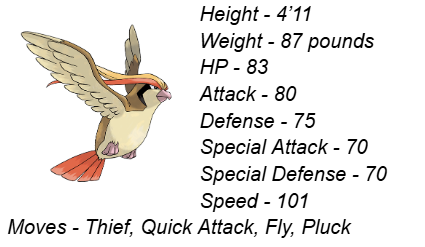
If Pidgeot had actual hands, they’d make a solid slot receiver. They’re still good as a defensive back, with the speed and intelligence to fly around the field and play consistent man coverage. In the right situation, it could probably even corral an underthrown ball in its wings and come away with an interception. The stats aren’t overwhelming, but compared to someone like Fearow, the size and well-roundedness is adventagous.
Gengar – Cornerback
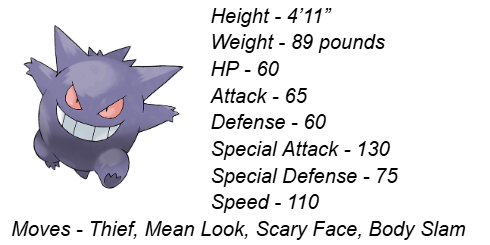
If Gengar was a little taller they would have worked as a quarterback. Gengar’s fast and smart, with the ability to levitate for contested balls and the hands to catch them. Also, as a ghost who could turn transpatent, I think it’ll be easy to avoid unnessesary pass interference calls. For some reason, I also think having at least one humanoid defensive back is a sound strategy, just in case you come up against a non-bird receiver with a more traditional build.
Jolteon – Free Safety
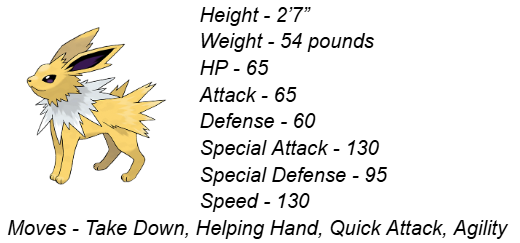
Jolteon is one of the fastest Pokémon in Generation I, with a Speed stat of 130, tied with Aerodactyl and behind only Electrode. Jolteon’s freakin’ tiny, even compared to the other Pokemon in this exercise, which means they’re probably not suited as a pass rusher against the offensive line. And they doesn’t have wings, which is something I think is kind of a necessity if you’re going to play man coverage against flying passcatchers. But that speed can’t be left on the bench, and free safety is the only place I can see it working.With that kind of burst, Jolteon can sit back in coverage and chase down the ball while it’s in the air. It can provide a second line of support against the run, make game-saving tackles, or serve as an extra blitzer in key situations.
Golbat – Strong Safety
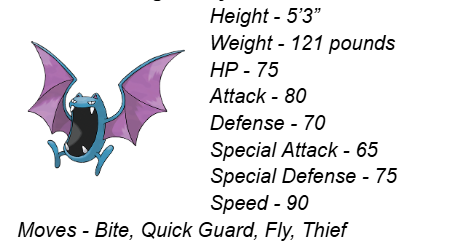
With its enormous mouth and broad wings, Golbat has some great tools for the secondary. Its wingspan should help it swat away passes, while its mouth gives it a plausible way to catch the ball. Moves like Thief could even help it come away with timely interceptions, and the Inner Focus ability will make pump fakes irrelivant. Golbat isn’t an elite athlete across the board, but with Jolteon’s lack of size and inability to fly, I wanted a more well-rounded player who could bring some traditional defensive-back skills to the secondary.

